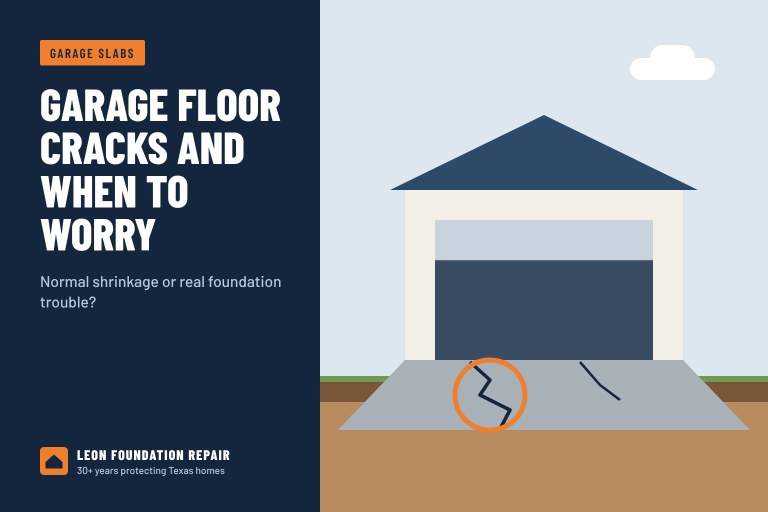
You pull the car out one Saturday morning and there it is. A crack running across the garage floor that you swear wasn’t there last year.
Maybe it’s thin as a hair. Maybe it’s wide enough to catch a screwdriver.
Garage floor cracks are one of the most common things Houston homeowners ask us about. Most are harmless. Some are an early sign the foundation is moving. Here’s how to tell which kind you’ve got.
Why Garage Floors Crack So Often
Garage slabs take a beating. They hold cars, tools, freezers and storage shelves. They sit next to driveways that funnel rainwater right up to the door.
Many garages are also poured a little differently from the house. In some homes, the garage is a separate section with its own joints. In others, it’s part of the main slab with a step down.
And concrete cracks. That’s not a flaw, it’s just what concrete does as it cures and as the ground beneath it shifts.
Shrinkage Cracks Are Normal
As concrete cures, it loses water and shrinks a little. That shrinking creates shrinkage cracks, usually within the first year or two after the pour.
They tend to be thin, fairly straight and spread out in no particular pattern. Builders cut control joints in the slab to guide where these cracks happen, but some still wander off on their own.
Shrinkage cracks don’t usually grow much after the first couple of years. They’re cosmetic, not structural.
Hairline Concrete Cracks
Hairline concrete cracks are thin enough that you can’t fit a credit card into them. Most cracks in a garage start this way, and most stay this way.
If a hairline crack stays the same width for years, it’s probably fine. Seal it if you want to keep out moisture and dirt, and move on. Honestly, most garages in Houston have a few of these, and they never turn into anything more.
When Garage Floor Cracks Become a Concern
Some garage floor cracks deserve a closer look. Watch for these signs.
- Cracks wider than about a quarter inch
- One side of the crack sitting higher than the other
- Cracks that keep getting longer or wider
- Cracks that line up with cracks in the house walls
- New cracks after a long drought or a major storm
That height difference is a big one. If you can feel a lip with your foot, the slab on one side has moved up or down. That’s movement, not just shrinkage.
Timing matters too. A crack that appears in a brand new garage is usually curing. A new crack in a 15-year-old garage after a dry summer is a different story, and it deserves a closer look.
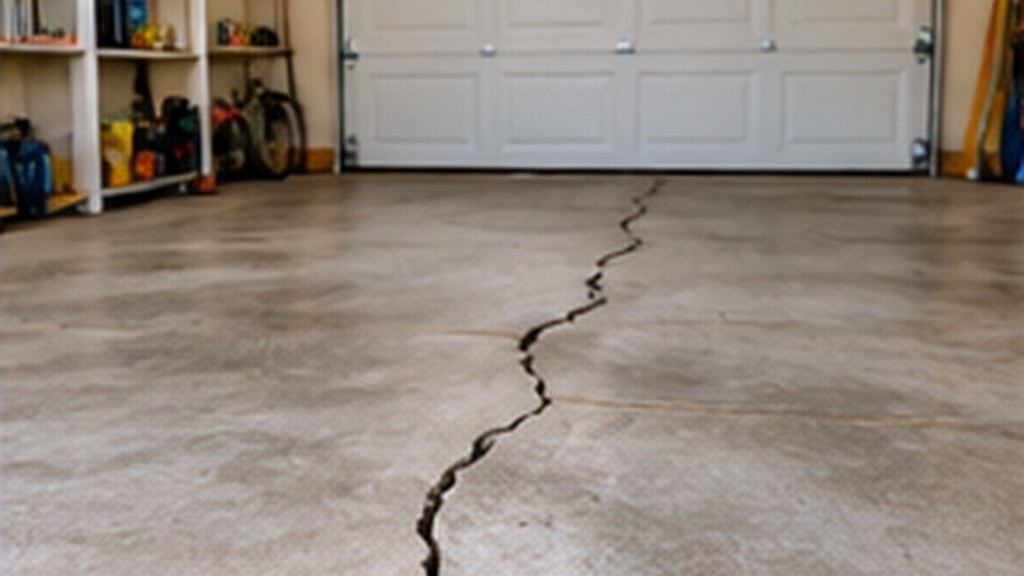
Heaving Garage Slab
Sometimes the floor doesn’t sink. It rises. A heaving garage slab happens when clay underneath soaks up water and swells.
Garages are especially prone to this. Rainwater often flows off the driveway and under the garage door. Downspouts may dump right at the corner. Over time, that extra water lifts part of the floor.
Heave can crack the slab in a dome or web pattern, or push one panel up against the next. Fixing the water problem usually comes first.
Cracks Spreading Into the House
This is the sign we take most seriously. If cracks spreading into the house start from the garage and continue through the wall or into the interior slab, the movement likely isn’t limited to the garage.
Look at the wall between the garage and the house. Check for cracks near the door into the kitchen or laundry room. Look at the brick outside the garage corners.
If the cracks connect, the foundation under that part of the house is probably moving. Our post on stair step cracks in brick explains what those exterior cracks mean.
How to Track a Crack
You don’t need special tools. Grab a pencil, a ruler and your phone.
Mark both ends of the crack with a small line and the date. Measure the width at its widest point. Take a photo with a coin or ruler next to it for scale.
Check again every month or two. If the crack passes your marks or gets wider, it’s time for a professional look. Keep the photos in one album so you can compare them side by side.
Is It the Garage or the Driveway?
Sometimes the crack is right where the garage floor meets the driveway. That joint takes a lot of stress, and the driveway often moves on its own.
Driveway cracks and sinking panels usually aren’t a foundation issue. But if the driveway tilts toward the house, it sends water right at the slab, and that can cause foundation problems later. Fixing the slope is worth doing.
How Garage Floor Cracks Get Fixed
The fix depends on the cause.
For shrinkage cracks and hairline cracks, a good concrete sealant or crack filler is usually enough. It keeps out moisture and makes the floor look cleaner.
For cracks caused by settlement, the foundation needs support. Piers go under the low area and the slab is lifted back toward level. Our post on foundation underpinning explains how that works.
For heave, the first step is drainage. Gutters, downspout extensions and grading can stop the water. In some cases, French drains help a lot, and our post on French drains for Houston foundations covers why.
Can You Just Patch It?
You can patch any crack. But patching a moving crack is like painting over a water stain on the ceiling. It looks better until it comes back.
If you patch a crack and it reopens, that’s useful information. It tells you the slab is still moving.
If you want to read more about how concrete cracks and why, the American Concrete Institute has homeowner-friendly resources on concrete behavior.
Keep Water Away From the Garage
Most garage slab problems we see trace back to water. A few small changes go a long way.
Make sure downspouts near the garage corners empty several feet away from the slab. Check that the driveway slopes away from the house, not toward it. Keep the area along the garage walls graded so water runs off instead of pooling.
If you wash cars or hose out the garage often, push the water out toward the street. Constant water at the slab edge feeds the clay and invites movement. Our post on Houston foundation drainage has more ideas.
Questions Homeowners Ask
Are cracks normal in a new garage?
Yes, small shrinkage cracks are very common in the first couple of years.
Will insurance cover cracks in my garage?
Usually not, unless they were caused by a sudden covered event.
Should I seal cracks before winter?
It’s a good idea. Sealing keeps water out, and less water under the slab means less movement.
Not Sure What Your Cracks Mean?
Most garage floor cracks are no big deal. A few are early warnings. The trick is knowing which is which.
We’ll take a look, measure the slab and give you an honest answer. Call (866) 617-0406 or book your free estimate today. Our full range of foundation repair services covers the rest.