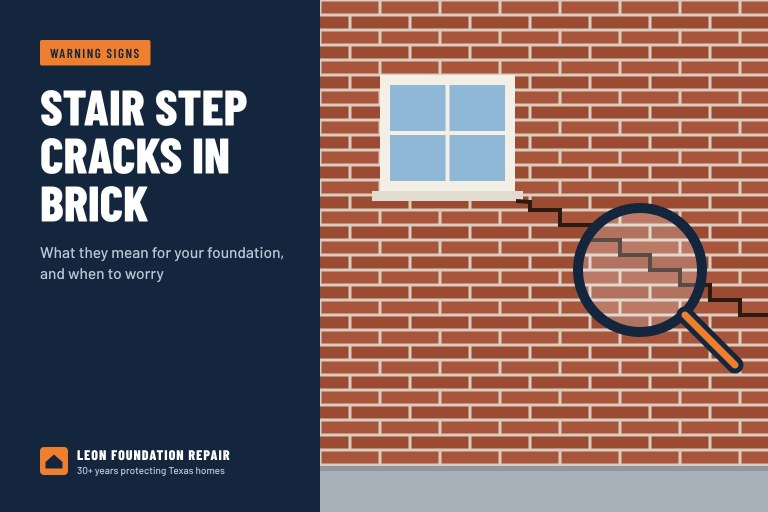
You’re walking around the house, maybe hosing off the flower beds, and you notice it. A crack zigzagging up the brick wall like a little staircase.
It wasn’t there last year. Or maybe it was, and it’s just bigger now.
Stair step cracks in brick are one of the most common reasons Houston homeowners call us. Some are harmless. Some are the first real sign the foundation is moving. Here’s how to tell the difference.
What Stair Step Cracks Look Like
These cracks follow the mortar lines between bricks. Instead of running straight, they step up or down at an angle, one brick at a time.
They often start near the corner of a window or door, or at the outside corner of the house. Sometimes they’re hairline thin. Sometimes you can slide a coin into them.
The pattern itself tells a story. Brick is strong, but mortar is weaker, so when the wall gets pulled or pushed, it breaks along the easiest path. That’s the mortar, in a stair-step shape.
What Causes Stair Step Cracks in Brick?
Most of the time, the cause is underneath. The wall is reacting to something the foundation is doing.
Foundation Settling
Foundation settling is the big one. When one part of the slab sinks lower than another, the brick wall above has to stretch to follow it. It can’t stretch, so it cracks.
Differential Movement
Differential movement is a fancy way of saying different parts of the house are moving by different amounts. In Houston, that’s usually clay soil drying out faster on one side, often the side that gets the most sun or sits near a big tree.
Moisture Changes in the Soil
Clay soil shrinks in dry weather and swells in wet weather. Over a hot Texas summer, the soil around the perimeter can pull away from the slab entirely. We explained more about it in our post on what Texas heat does to the soil beneath your home.
Thermal Expansion and Normal Shrinkage
Not every crack is a foundation problem. Brick and mortar expand and contract with temperature. New homes also go through a bit of settling in their first few years. Small, stable cracks from these causes are common.
Brick Veneer Cracks vs Structural Cracks
Most Houston homes don’t have structural brick walls. They have brick veneer, a single layer of brick attached to the wood frame behind it.
That matters. Brick veneer cracks usually aren’t a sign the wall is about to fall. The brick isn’t holding the house up. But the cracks still tell you the foundation under that wall is moving, and that’s what you need to pay attention to.
When Stair Step Cracks in Brick Are Serious
Here’s a simple way to size things up. Cracks are more likely to be a real foundation concern when:
- They’re wider than about a quarter inch
- They keep getting longer or wider over a few months
- The brick on one side of the crack sits out further than the other
- You see mortar joint separation where the gap opens wider at one end
- Doors and windows nearby start sticking or won’t latch
- Cracks show up inside the house in the same area
One hairline crack that hasn’t changed in years is usually not a crisis. Several growing cracks plus sticking doors usually is.
How to Track a Crack Yourself
You don’t need special tools. A pencil and a phone are plenty.
Mark both ends of the crack with a small pencil line and write the date next to it. Take a photo with a coin or a ruler beside it for scale. Then check back every month or two.
If the crack grows past your marks, or the gap gets wider, it’s time for a professional look. Our page on signs of foundation issues lists other things to check while you’re at it.
Why Patching the Crack Isn’t Enough
It’s tempting to grab a tube of mortar and fill it in. And sure, that makes the wall look better.
The problem is it doesn’t fix why the crack happened. If the foundation is still moving, the patch will crack again, often right next to the old one. Worse, it can hide how much movement is really going on.
We see this all the time, and it’s one of the mistakes we covered in our post on DIY foundation repair. Fix the cause first. Patch the brick last.
How We Fix What’s Causing the Cracks
First comes an inspection. We measure elevations across the slab to see exactly where and how far the house has moved. Then we look at drainage, trees and anything else feeding the problem.
If the foundation has settled, the fix is usually underpinning. Piers go under the low area and reach firmer soil, then the house is carefully lifted back toward level. Often, cracks close up partially once the wall is supported again.
After that, any remaining cracks can be tuckpointed or repaired by a mason, and this time the repair actually holds.
Can You Prevent Stair Step Cracks?
You can’t control the weather, but you can tip the odds in your favor.
Keep soil moisture around the foundation steady during dry spells. Make sure gutters and downspouts dump water well away from the house. Keep big thirsty trees from growing too close to the slab.
If you like digging into the engineering side, the Houston-based Foundation Performance Association shares technical papers on foundation movement and repair.
Other Cracks Worth Knowing About
Stair step cracks aren’t the only pattern out there. A few others show up on Houston homes too.
Vertical cracks that run straight up and down are often from normal shrinkage, especially if they’re thin and even. Horizontal cracks in brick are less common and can point to bigger pressure on the wall, so they deserve a closer look.
Cracks inside the house matter too. Diagonal cracks running off the corners of doors and windows in drywall often show up alongside exterior stair step cracks. When you see both on the same side of the house, the foundation under that area is the first place to look.
Common Questions From Homeowners
Will insurance pay to fix the cracks?
Usually not, if they come from normal settling. Coverage is more likely when a sudden event like a burst pipe caused the movement.
Can I sell a house with cracked brick?
You can, but buyers and inspectors will notice. Fixing the cause first, with a transferable warranty, usually makes the sale smoother.
Should You Worry About Stair Step Cracks in Brick?
Worry? No. Pay attention? Yes.
Stair step cracks in brick are your house’s way of telling you something underneath is shifting. Catch it early and the repair is usually simpler and cheaper. Ignore it and the cracks tend to multiply, along with the bill.
Get a Second Set of Eyes on It
Not sure if your crack is normal or a warning sign? That’s exactly what our free inspections are for.
We’ve been reading cracks on Houston homes for over 30 years. Learn more about our foundation repair work, or call (866) 617-0406 to schedule a visit. We’ll tell you honestly whether it needs fixing or just watching.